
Delta Neutral Strategies in DeFi: How They Work and What Breaks Them
 Thomas Cosialls
A delta neutral strategy in DeFi pairs a long and a short position on the same asset so that price moves cancel out, and the position earns from something other than price: perpetual funding, staking rewards, lending interest, or trading fees. With a net delta of zero, ETH can rise or fall 10% and the portfolio barely moves. What you keep is the yield, minus the cost of keeping the two legs balanced.
That last clause is where most guides stop and where most of the risk lives. This article covers the five delta neutral strategies DeFi actually uses, works through the math with real numbers (including a hedged concentrated-liquidity position, the one we build automation for), and then looks at what broke these positions in practice, from negative funding to the auto-deleveraging of October 10, 2025.
What does delta neutral mean?
Delta is how much a position's value changes when the underlying price moves by one unit. Holding 1 ETH has a delta of +1: if ETH gains $100, you gain $100. A 1 ETH short perpetual has a delta of −1. Hold both and the net delta is zero: the two legs move by equal and opposite amounts, so the price stops mattering.
Some positions have a delta that changes as the price moves. That rate of change is gamma. Spot ETH and perps have zero gamma (one ETH is always one ETH of exposure), but a liquidity position does not: as ETH rises, an AMM sells your ETH for stablecoins, so your exposure shrinks. That single fact explains why delta neutral is a state you maintain rather than a trade you enter once. A basis trade can sit untouched for weeks; a hedged LP position drifts away from neutral with every swap through the pool.
Where does delta neutral yield come from?
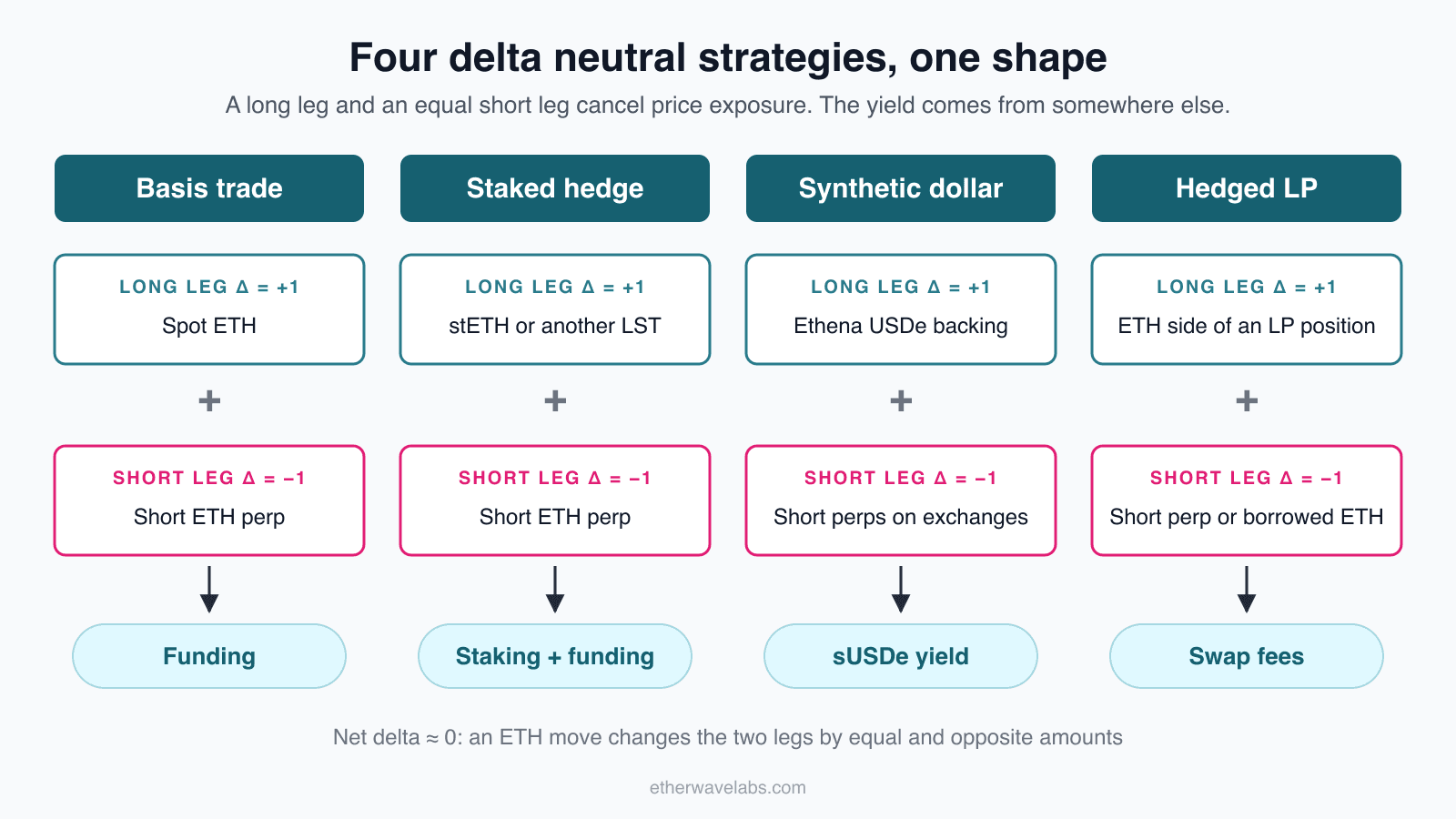
Removing price exposure removes the main source of crypto returns, so the yield has to come from somewhere else. In DeFi there are four places it comes from:
- Perpetual funding. Perpetual futures have no expiry, so exchanges keep their price close to spot with periodic payments between longs and shorts. When traders are net long, which is the usual state of crypto markets, longs pay shorts. A short perp is both the hedge and the income.
- Staking rewards. A liquid staking token such as stETH keeps earning Ethereum staking yield while its price exposure is hedged.
- Lending spreads and incentives. Supplying collateral earns interest, and borrowing a volatile asset is itself a short position.
- Trading fees. Liquidity providers earn a cut of every swap through their range, which is the only one of the four that comes from real trading activity rather than from other traders' leverage.
How perpetual funding works on Hyperliquid
Funding mechanics differ between venues, and the details decide your yield. On Hyperliquid, one of the largest onchain perp exchanges, funding is paid every hour and computed as:
Funding rate (8h) = average premium + clamp(interest rate − average premium, −0.05%, +0.05%)
The interest rate component is fixed at 0.01% per 8 hours, which Hyperliquid's docs annualize to 11.6% APR paid to shorts. Because of the clamp, whenever the average premium sits within 0.05% of that 0.01% baseline, the clamp cancels it exactly and the funding rate equals the baseline. In other words, in calm markets a short perp on Hyperliquid earns roughly 11.6% a year on its notional, and the rate only moves away from that floor when the perp trades at a real premium or discount to spot. Funding is capped at 0.5% per hour, which is still enough to swing far in either direction during a squeeze.
Two things follow. First, quoting "historical 15 to 30% APY" for funding trades, as many guides do, says little: what matters is how often the premium leaves the baseline band, and in which direction. Second, funding is paid on notional, not on margin, so how you size the short leg changes the yield on your total capital (see the worked example below). If you are new to how onchain perp exchanges match orders, our comparison of order book DEXs and AMMs covers the market structure.
Five delta neutral strategies in DeFi
1. Spot plus short perp: the basis trade
The classic cash-and-carry. Buy spot ETH, open a short ETH perpetual of the same size, collect funding. Price moves cancel; funding accrues to the short.
The worked numbers, with $100,000 of capital and ETH at $3,000:
- Buy $75,000 of spot ETH (25 ETH).
- Deposit $25,000 USDC as margin on Hyperliquid and short 25 ETH, also $75,000 of notional. The short runs at 3x leverage on its margin.
- At the 11.6% baseline, funding pays about $8,700 a year, or 8.7% on the full $100,000, before trading fees.
- The short is liquidated if ETH rallies by about 31% before you top up the margin (assuming a 2% maintenance margin; check the current tier for your asset). The spot ETH gained just as much, but it sits in a different place and cannot cover the margin call on its own.
That last point is the operational core of every perp-hedged strategy: the two legs gain and lose in different accounts. A delta neutral book is flat overall but needs fresh margin on the losing side during a sharp move, which means moving USDC between chains and venues quickly. We documented that plumbing, including deposits into and withdrawals from Hyperliquid, in our Circle CCTP and Hyperliquid guide.
The trade-off is between yield and safety: a larger spot leg raises the funding income but thins the margin buffer. Most operators keep the short at 2x to 3x and rebalance margin from spot gains when a rally eats into it.
2. Staked asset plus short perp: the staked hedge
Replace spot ETH with a liquid staking token such as stETH, and keep the same short perp. You now earn the Ethereum staking yield (a few percent a year) on the long leg on top of funding on the short leg. This is the do-it-yourself version of what Ethena does at scale.
The added risk is the gap between the two legs. Your long leg is stETH, your short leg is ETH. If stETH trades at a discount, the hedge stops being perfect: in June 2022, stETH traded about 6% below ETH as leveraged holders were forced to sell. You can also use the LST as collateral on a lending market to borrow stablecoins for the perp margin, but every layer adds another liquidation threshold to watch.
3. Synthetic dollars: Ethena USDe and sUSDe
Ethena packages the staked hedge into a token. Minting USDe deposits collateral (staked ETH, BTC, or stablecoins), and Ethena opens matching short perpetual positions on exchanges, so the backing is delta neutral and USDe stays near $1. Staking USDe into sUSDe passes the funding and staking income to holders. A reserve fund absorbs periods of negative funding.
The yield follows the funding market closely. According to Ethena's Q3 2026 governance update, the 7-day average sUSDe APY rose from 3.8% at the start of July 2026 to 5.0% at the end of September, well below the double-digit yields of the 2024 bull market. That is the main lesson of synthetic dollars: you are buying the funding rate, whatever it happens to be.
Buy or build? sUSDe is the simplest way to own a delta neutral yield, with no margin to manage. In exchange, you take on Ethena's counterparty and custody setup, its exchange exposure, and the secondary-market price of USDe itself, which can diverge from the backing in a crash (more on October 10 below). Running the trade yourself costs operational effort but keeps control of venue choice, leverage, and timing.
4. Hedged liquidity provision: the delta neutral LP
This is the strategy that earns from trading activity, and the one with the most math. You provide liquidity to an ETH/USDC pool to earn swap fees, then short the ETH your position holds, so the fees are what remains.
The delta of a concentrated liquidity position. In a Uniswap v3 or v4 position with liquidity L and range [Pa, Pb], the amount of ETH held at price P is:
ETH held = L × (1/√P − 1/√Pb) when Pa ≤ P ≤ Pb ETH held = L × (1/√Pa − 1/√Pb) when P < Pa (all ETH) ETH held = 0 when P > Pb (all USDC)
The position's delta is exactly the ETH it holds, so that is the size of the short you need. Its gamma, the change in delta per $1 of price, is −L / (2P^1.5): always negative, which is the formal way of saying the pool sells ETH as it rises and buys it as it falls.
A worked example. Deposit $100,000 into ETH/USDC at $3,000 with a range of $2,400 to $3,750. The position starts as 16.67 ETH plus $50,000 USDC (L ≈ 8,647 in human units). To be delta neutral, short 16.67 ETH, about $50,000 of notional. Then let the price move without touching the hedge:
| ETH price | ETH in the position | Unhedged LP P&L | Hedged LP P&L |
|---|---|---|---|
| $2,700 (−10%) | 25.21 | −$6,247 | −$1,247 |
| $2,850 (−5%) | 20.77 | −$2,804 | −$304 |
| $3,000 | 16.67 | $0 | $0 |
| $3,150 (+5%) | 12.86 | +$2,211 | −$289 |
| $3,300 (+10%) | 9.32 | +$3,872 | −$1,128 |
| $3,750 (range top) | 0 | +$5,902 | −$6,598 |
Two results matter here. The hedge removed the direction: a 10% move now costs about $1,100 to $1,250 instead of swinging the position by $4,000 to $6,000. But the hedged P&L is negative in both directions, and it grows with the square of the move. A 5% move costs about $300; a 10% move costs four times that.
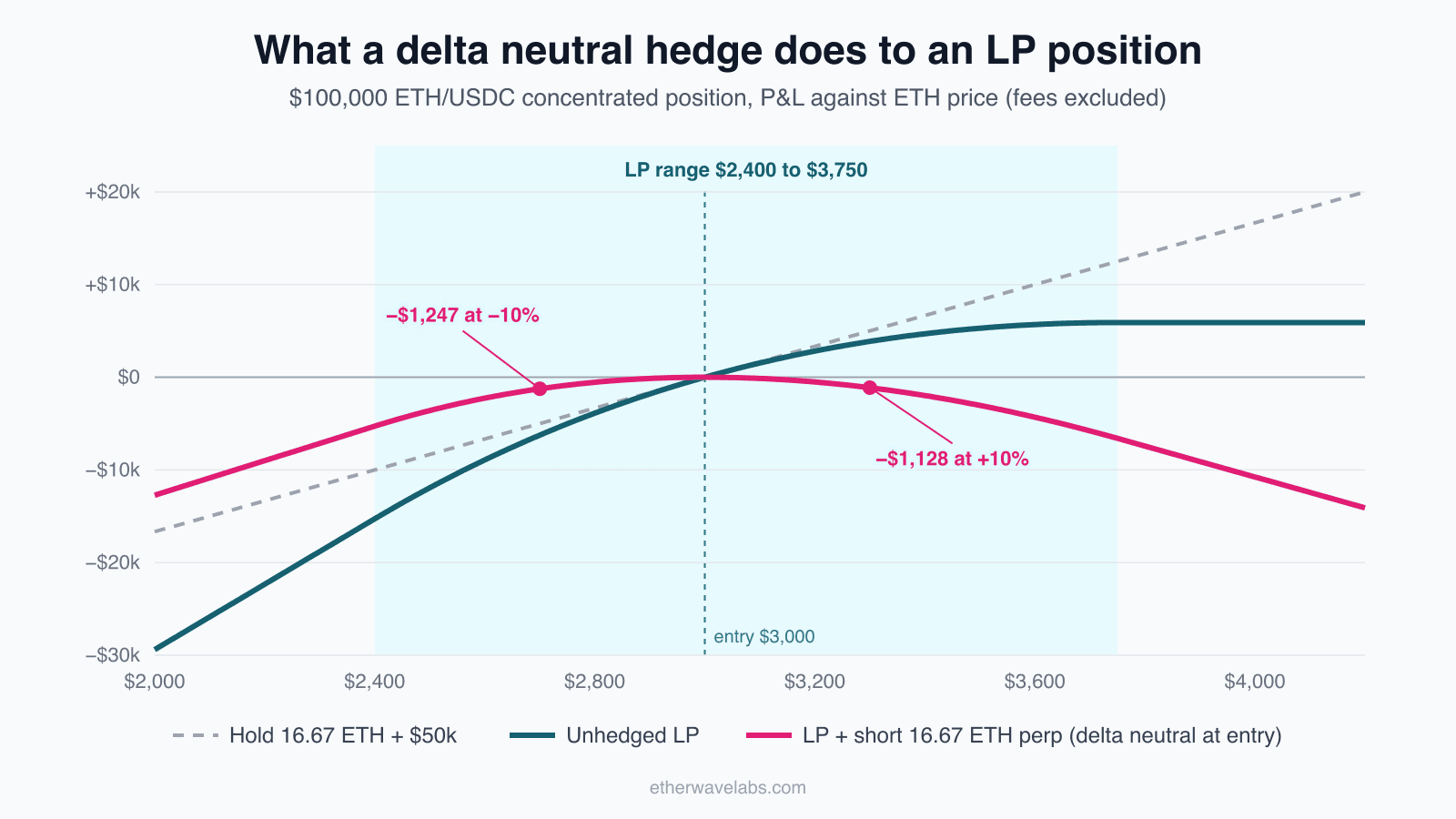
Delta neutral does not remove impermanent loss. This is the most common misconception in delta neutral LP guides. Check the $3,300 row: holding the starting 16.67 ETH and $50,000 would be worth $105,000, while the LP is worth $103,872. The $1,128 gap is the impermanent loss, and it is exactly the hedged P&L. A static short of the starting ETH balance cancels the "hold" part of the position, which leaves you with impermanent loss and nothing else. Hedging isolates impermanent loss; it does not eliminate it. Rebalancing the hedge more often changes the shape of the cost (you pay it in small realized slices, roughly ½ × |gamma| × move² each time) but not its existence.
So a delta neutral LP is a bet that fees plus funding beat the gamma cost. On Hyperliquid, the short leg also earns funding: about $5,800 a year on the $50,000 hedge at the baseline rate. The position pays when ETH moves sharply in a short time, especially when it leaves the range, which is why range width, rebalance rules, and exit rules matter more than the hedge itself.
Rebalancing the hedge. After the move to $3,300, the position holds 9.32 ETH but you are short 16.67, so you are now net short 7.35 ETH. Buying back 7.35 ETH of the short (about $24,000 of notional) restores neutrality, and costs about $11 at a 0.045% taker fee. The decision is how often: rebalance too rarely and you carry directional risk; too often and fees and slippage eat the yield. Most systems use a drift band, rebalancing only when the hedge is more than 5 to 10% off target, plus a forced rebalance when the price exits the range. Above the range, the position is 100% USDC with zero delta, so any remaining short is a naked short and has to be closed.
Here is that logic in TypeScript, with liquidity and prices in human units (convert from sqrtPriceX96 and token decimals first):
// ETH (token0) held by a concentrated liquidity position = its delta
export function positionDelta(liquidity: number, price: number, lower: number, upper: number) {
  const p = Math.min(Math.max(price, lower), upper)
  return liquidity * (1 / Math.sqrt(p) - 1 / Math.sqrt(upper))
}

// How much to change the short. Positive: short more. Negative: buy back.
export function hedgeOrder(targetShort: number, currentShort: number, band = 0.05) {
  const drift = targetShort - currentShort
  const tolerance = Math.max(targetShort, currentShort) * band
  return Math.abs(drift) > tolerance ? drift : 0
}

const L = 8646.84
const target = positionDelta(L, 3300, 2400, 3750) // 9.32 ETH
hedgeOrder(target, 16.67) // -7.35: buy back 7.35 ETH of the short
The position side of this loop (collecting fees, moving the range, closing out) is the same lifecycle we walk through in our Uniswap v4 liquidity management tutorial, and for Solana pools in our guide to collecting fees from Orca Whirlpool positions. Before committing capital, model the range against realistic volatility: that is the job Metrix Finance, a liquidity pool simulator we built the front end and data layer for, does for LPs. And when the strategy is packaged as a vault, the hedging and rebalancing move onchain or into a keeper, as in YieldBase, the non-custodial active liquidity manager we built with Solidity vaults and subgraph indexing.
5. Borrow-hedged LP and other variants
Instead of a perp, hedge an LP position by borrowing the volatile asset. Supply USDC to a lending market, borrow ETH equal to the LP's ETH balance, and pair it into the pool: the ETH debt is your short leg. It keeps everything onchain, with no perp exchange or cross-venue margin, but the economics flip. A perp short earns funding, while an ETH loan costs borrow interest. The liquidation risk also moves: a rally grows your ETH debt against fixed USDC collateral, so you watch a health factor instead of a margin ratio. How liquidations happen depends on the market design: most lending protocols liquidate at an oracle price, while oracle-free designs such as the Ethereum Credit Guild, a lending protocol we built the full front end for, resolve bad loans through onchain auctions instead.
Two more variants are worth knowing:
- Cross-venue funding arbitrage: long the perp where funding is low or negative, short it where funding is high. No spot leg, but two sets of margin and two venue risks.
- Options-based hedges: onchain options venues let you hedge gamma, not just delta, at the price of a premium. This is the only family on this list that can address the curvature cost of a hedged LP position, and also the least liquid.
Delta neutral strategies compared
| Strategy | Yield source | Main risk | Rebalancing | Complexity |
|---|---|---|---|---|
| Basis trade | Funding | Funding turns negative, short liquidated on rallies | Margin top-ups | Low |
| Staked hedge | Staking + funding | LST discount, two liquidation thresholds | Margin top-ups | Medium |
| Ethena sUSDe | Funding + staking (packaged) | USDe secondary price, exchange exposure | None for the holder | Low |
| Hedged LP (perp) | Swap fees + funding | Gamma cost, range exits | Continuous hedge adjustment | High |
| Borrow-hedged LP | Swap fees − borrow interest | Health factor on rallies, oracle risk | Continuous, onchain | High |
What breaks a delta neutral position?
Delta neutral means hedged against price, not against risk. These are the failure modes that have actually hit these strategies:
- Funding flips negative. In bear markets, shorts pay longs, and the yield of a basis trade or synthetic dollar turns into a cost. Ethena keeps a reserve fund for these periods; a DIY position needs an exit rule.
- The short leg is liquidated on a rally. The book is flat overall, but if the margin on the short runs out before you can move collateral from the long side, the hedge is gone and you are left long at the top. Margin buffers and fast cross-venue transfers are the defense.
- Auto-deleveraging. On October 10 and 11, 2025, over $19 billion of leveraged positions were liquidated, the largest such event in crypto history. When insurance funds could not absorb the losses, exchanges used auto-deleveraging (ADL) to force-close profitable positions against bankrupt ones. For a delta neutral trader, the profitable leg in a crash is the short, so ADL closed hedges and left many books unhedged and long during the fall. ADL is the risk most guides never mention, and no margin buffer protects against it.
- The asset you hold is not the asset you shorted. During the same crash, USDe traded as low as about $0.65 on Binance while onchain redemptions held near $1. Any strategy using USDe or an LST as collateral at a venue's own marked price felt that gap, even though the backing was intact.
- Venue and counterparty failure. When FTX collapsed in November 2022, traders whose short legs and margin sat there lost both, leaving them with naked spot exposure. Splitting legs across venues reduces this risk but increases the margin-transfer risk above.
- Smart contract and hook risk. Every protocol in the stack (the pool, the lending market, the vault, the bridge) adds a contract that can fail. On Uniswap v4, a hook attached to a pool can change fees or withdrawals, so read it before you deposit.
- Gamma and costs. For hedged LPs, a sharp move costs money even when everything works as designed (see the table above), and every rebalance pays fees and slippage.
How to run a delta neutral strategy
The strategies differ, but the running checklist is the same:
- Size the margin for the move you cannot react to. If you can top up within an hour, plan for the largest hourly move you have seen, not the daily average. A 3x short survives a 31% rally; a 10x short survives about 8%.
- Monitor four numbers continuously: net delta (in asset units, not dollars), margin ratio or health factor on every leveraged leg, funding rate and its trend, and, for LPs, the price relative to your range.
- Rebalance with a drift band, not a clock. Rebalancing every hour pays fees for nothing in quiet markets and reacts too late in volatile ones. A 5 to 10% drift band plus range-exit triggers is a sensible default.
- Write the exit rules first. Negative funding for N days, a collateral depeg beyond a threshold, an ADL event, a range exit: decide in advance what closes the position.
- Automate it, then simulate before you sign. A hedged position that depends on someone watching a screen at 3 a.m. is not delta neutral; it is delta neutral until the first night it isn't. Simulate every transaction before it is sent, and alert when a check fails.
Frequently asked questions
Is a delta neutral strategy risk-free?
No. It removes first-order price exposure and nothing else. Funding rates, liquidations of a single leg, auto-deleveraging, depegs, venue failures, and smart contract bugs all remain, and hedged LP positions also lose money on large moves through gamma.
What returns do delta neutral strategies earn?
They track their yield source. A short perp on Hyperliquid earns an 11.6% APR baseline on its notional in calm markets, which becomes roughly 8 to 9% on total capital once you hold the spot leg and margin. sUSDe paid between 3.8% and 5.0% (7-day average) between July and September 2026. Hedged LP returns depend on pool fees versus volatility and can be negative in fast markets.
Does a delta neutral hedge remove impermanent loss?
No. A static hedge of an LP position's starting ETH balance makes its P&L exactly equal to impermanent loss. Hedging removes the directional part of the position, and impermanent loss is what is left. The fees have to cover it.
Should I use Ethena or build my own delta neutral position?
Use sUSDe if you want a delta neutral yield without managing margin, and accept Ethena's counterparty, exchange, and secondary-market risks. Build your own if you need control over venues, leverage, and exits, or want a yield source Ethena does not offer, such as LP fees.
How much capital do you need?
There is no protocol minimum, but costs set a practical floor. Every position pays to open, close, and rebalance, and on Ethereum mainnet gas alone can eat the yield of a small position. On L2s and Hyperliquid, a few thousand dollars is workable for a basis trade; a hedged LP position needs enough size that rebalancing fees stay small relative to swap fees.
From strategy to system
A delta neutral position is a small control system: measure delta, compare it with the hedge, act within a band, and stop when a risk check fails. The math fits on one page. Keeping it running through a 3 a.m. liquidation cascade is the hard part.
That system is what we build at Etherwave Labs. Our liquidity management automation runs non-custodial rebalancing, fee compounding, and monitoring for concentrated liquidity positions on Uniswap v3/v4, Slipstream, Algebra, Raydium, and Orca, and we built the vaults behind YieldBase and the simulator behind Metrix Finance. If you are designing a delta neutral vault or want your hedged positions to manage themselves, talk to us.