

Tuo
A non-custodial yield platform that hedges Uniswap V3 liquidity with Hyperliquid shorts, audited by Cyfrin and deployed on Arbitrum One.
- Client
- Tuo
- Year
- Service
- End-to-end protocol development: Solidity smart contracts, NestJS backend with a keeper, Next.js dApp and operations console, subgraph, and the USDC bridge to Hyperliquid.
Overview
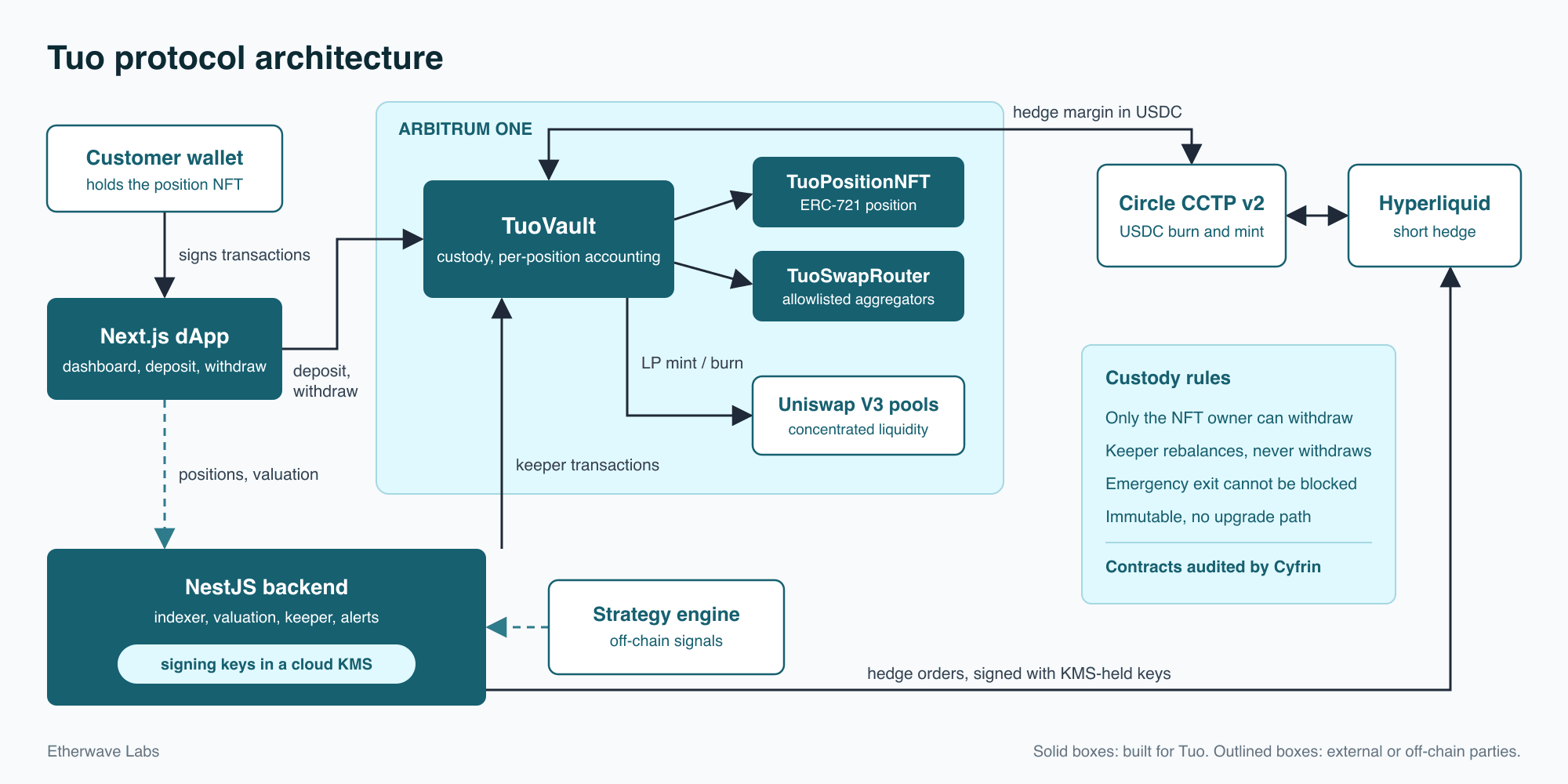
Tuo is a non-custodial yield platform on Arbitrum One. A customer deposits ETH, WETH, WBTC or USDC. The platform converts the deposit to USDC, provides it as concentrated liquidity in Uniswap V3 pools, and opens a matching short position on Hyperliquid so the position earns trading fees while its price exposure is hedged. Each position is a transferable ERC-721 NFT, and whoever holds the NFT is the only one who can withdraw.
The challenge
The strategy lives on two venues: liquidity on Arbitrum and a perpetual short on Hyperliquid, with USDC margin moving between them. An automated keeper has to rebalance positions around the clock, yet it must never be able to take customer funds, and a customer must always be able to exit, even if the operator goes offline. The contracts also had to pass an independent audit before holding real deposits.
What we built
We designed and built the whole protocol: three Solidity contracts for custody and accounting, a NestJS backend that indexes the chain, values positions and runs the keeper with keys held in a cloud KMS, a Next.js dApp with a portfolio dashboard and deposit and withdrawal flows, and the USDC bridge to Hyperliquid over Circle CCTP. The strategy engine that decides ranges and hedge sizes runs off-chain and stays private. Cyfrin audited the contracts in September 2026, and the protocol is deployed on Arbitrum One mainnet with verified source code.
- solidity
- foundry
- arbitrum
- uniswap v3
- hyperliquid
- circle cctp
- nestjs
- next.js
- wagmi
- viem
- subgraph
- aws kms
Architecture
- Smart contracts
- Three contracts, deployed in a single transaction so there is never a live but unconfigured state. TuoVault is the custody and accounting core: it holds idle tokens and the Uniswap V3 LP NFTs, and tracks each position's balances, hedge margin, withdrawal state and performance-fee basis. TuoPositionNFT is the ERC-721 that represents a position. TuoSwapRouter executes swaps through allowlisted aggregators with exact-amount approvals. The contracts are not upgradeable, roles are split between a multisig treasury, a keeper and a pauser, and no single key can reconfigure the system. Prices come from pool TWAPs with a deviation gate against manipulation.
- Backend and keeper
- A NestJS service is the off-chain source of truth: an indexer follows the contract events, a valuation job computes each position's net asset value, and a dispatcher turns the strategy engine's signals into keeper transactions. The keeper can swap, mint and burn liquidity and move hedge margin, within on-chain budgets, but it can never withdraw. Its key and the Hyperliquid signing keys live in a cloud KMS and never appear in an environment variable or in the repository.
- Bridge to Hyperliquid with CCTP
- Hedge margin travels between Arbitrum and Hyperliquid over Circle CCTP v2, a burn-and-mint bridge for native USDC that settles in seconds. Each position gets its own dedicated Hyperliquid account, so there are no shared accounts and no pooled margin. The vault records the USDC that actually came back, never the amount it expected.
- Frontend
- A Next.js dApp with Sign-In with Ethereum, built on wagmi and viem. The dashboard shows each position's value, range and hedge. Deposits accept several tokens and withdrawals take two wallet calls: request, then withdraw once the position is unwound. An emergency exit pays the position out in kind if the unwind has not completed after 24 hours. A separate operations console lets the team monitor valuations, system health and the keeper queue.
- Data and monitoring
- A subgraph on The Graph provides a public, read-only index of the contract events, and alerts warn the team when a position or a dependency needs attention.
Highlights
- Smart contracts audited by Cyfrin (September 2026)
- Deployed on Arbitrum One mainnet, source verified on Arbiscan
- Non-custodial by design, the position NFT holder is the only withdrawal authority
- Keeper and Hyperliquid signing keys held in a cloud KMS
- USDC bridged to Hyperliquid with Circle CCTP v2
- Non-upgradeable contracts with an emergency exit that the operator cannot block
Results
- critical findings in the Cyfrin audit
- 0
- audit findings fixed, including all 3 high-severity ones; the other 8 acknowledged
- 32 / 40
- mainnet deployment with verified source code
- Arbitrum One
Keep exploring

YieldBase
A non-custodial active liquidity manager that routes capital to the best-performing pools.

Ethereum Credit Guild
The frontend for an oracle-free lending and borrowing protocol with on-chain governance.